
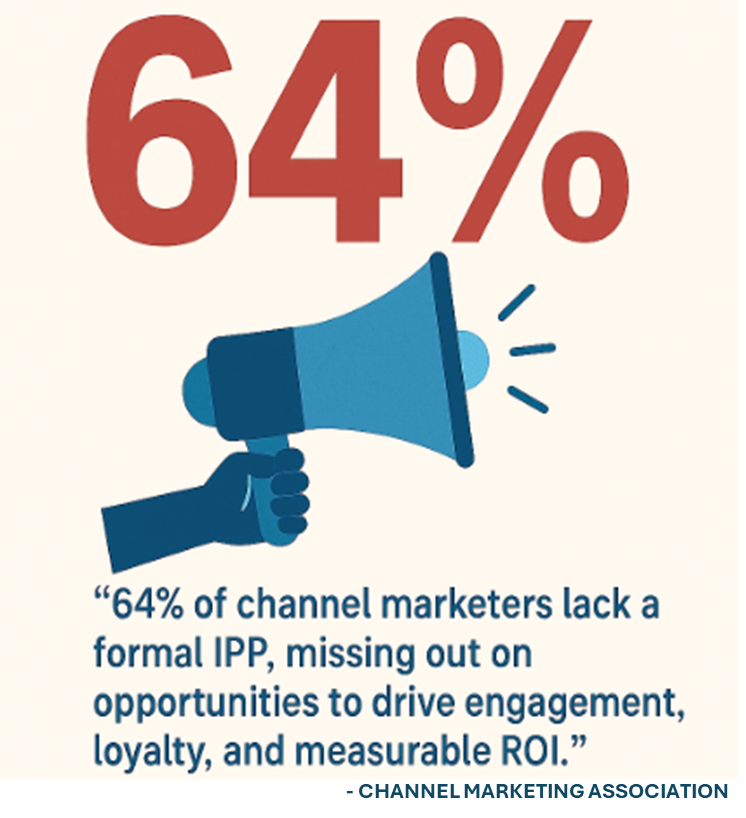
If you lead partnerships at a growth-stage or enterprise B2B tech company, your Ideal Partner Profile (IPP) is more than a nice-to-have checklist to revisit annually. Your IPP is one of THE most powerful strategic tools for deciding exactly where to invest your limited resources: time, headcount, marketing dollars, enablement, co-sell effort, and executive bandwidth.
Having an up-to-date, fine-tuned, forward-looking IPP is the foundation for faster partner activation, higher ROI, and predictable revenue. Treating it as an afterthought or as an exercise that AI can do for you can be a costly mistake.
Without a clear IPP, your sources scatter across anecdotes, internal politics, “familiar” brands, or random inbound leads. The result? You’re left holding a bloated partner roster that looks impressive on paper but delivers almost nothing to the bottom line.
Casual vs. Professional Partner Strategy
Think about it this way: A casual golfer can show up, swing freely, and accept the outcome. A pro golfer cannot. Every shot has consequences. If partnerships are a side hustle, sure- wing it.
For most B2B tech companies today, partner-sourced deals close faster, at hi
gh win rates, and with larger deal sizes. Partnerships are core to the revenue engine.
Channel pros can’t afford to swing freely and hope for the best. They need to partner with intention.
The Ideal Partner Profile Is Your North Star for Partner Investment
An Ideal Partner Profile is a forward-looking definition of the partners who will best accelerate your strategic goals. It’s the B2B equivalent of an Ideal Customer Profile (ICP) but broader and more nuanced because partners bring their own business models, niche expertise, ecosystems and economics to the table.
A Strong IPP Requires the Following:
-
- Target customer profile (ICP)
- Partner type and business model (eg. SI, reseller, MSP, ISV, distributor)
- Technology stack, competencies, specializations,certifications and cloud ecosystem alignment ( eg. hyper-scalers: AWS, Microsoft, GCP).
- Competitive exposure and conflict areas
- Industry and vertical focus
- Go-to-market motion (services-led, product-led, co-sell, referral) and monetization
- Partner program maturity and marketing readiness
- Stakeholder alignment for each defined IPP tied to company’s strategic short and long term objectives.
A strong IPP guides your entire organization — sales, product, marketing, alliances, and the exec team — to align upfront on what success looks like when partnering. Reducing partner strategy to finding an MSP who sells to more than 1,000 seats in the U.S. is like reducing sales strategy to calling for more leads. It takes a combined stakeholder effort to map the IPP candidate to your strategic goals.
Recent Trends Show IPPs Are More Critical Than Ever
The Partnership Leaders “Ecosystem Compass Report 2025”by Atlas and Bridge Partners, found that 73% of companies now directly align partnerships to overall business strategy, with many deriving 30–60% of revenue through partners and seeing 20%+ YoY partnership revenue growth.
KPMG research as reported in ChannelVisionMagazine echoes this: 75% of leaders view ecosystem partnerships as pivotal to growth, with “technological compatibility” and “agility” topping the list of must-have partner attributes.
Companies with well-defined IPPs consistently report higher partner engagement, more qualified leads, faster activation, better close rates, and dramatically less wasted effort. In short: precision beats volume.
AI Does Not Replace IPP Strategy
There is a growing misconception that AI can simply “figure out” the best partners without structured input and intent. Some partner discovery tools claim that you don’t need an IPP to find new partners. Some push the idea that IPPs should be treated as an “output” – let AI scan your website and auto-generate your IPP. The pitch sounds alluring: skip the hard strategic work and let the algorithm figure it out.
That approach is dangerously reactive and oversimplified. AI excels at processing massive datasets, mirroring back and spotting patterns. But AI cannot define your company’s unique strategic priorities for you.
Without a clear human-defined IPP as guardrails, AI just produces noise faster – more partners, less relevance, and the same old false momentum. It’s a false sense of security. Leveraging real world transaction data is useful but it’s incomplete, biased or based on suboptimal early choices. Waiting for “patterns to emerge” without strategic direction wastes quarters and burns budgets.
Partner Type Matters (A Lot)
Warning: Some are claiming that old distinctions like “SI vs reseller” or “MSP vs ISV” no longer matter because models have blurred. That perspective lacks nuance about partner types and the value they deliver to customers.
Different partner types still sell, influence, build, service, implement, monetize, compete and scale and deliver value in fundamentally different ways. Ignoring those differences makes it impossible to design effective partner programs, forecast pipeline or allocate resources intelligently. Precision in partner classification remains table stakes.
When you leverage AI for partner discovery and partner segmentation, you’ll want to ensure that the data model accurately deciphers an MSP, a VAR, a System Integrator, an ISV, etc.
The Real Danger: False Momentum
A well thought-out IPP built on the layers discussed above help prevent organizations from falling into the familiar trap of frenzied activity with zero meaningful revenue impact.
While your teams feel productive and leadership sees “progress,” pipeline stays flat, quarters slip, budgets get questioned , and credibility erodes. All because you partnered with companies that were never built to succeed with you.
Sidestep the Trap: Stakeholder Alignment Is the Real Superpower
The hardest – and most challenging – part of building an IPP isn’t the document itself. It’s getting sales, product, marketing and the C-suite to agree on the “why” behind it.
The alignment is pure gold. It prevents Sales from rejecting partners, Marketing targeting the wrong audiences, and Product from building for the wrong ecosystem. An IPP turns partnerships from an isolated function into a company-wide growth engine. An AI generated partner list cannot do the same.
The Bottom Line
Without an Ideal Partner Profile you risk burning quarters and resources because you didn’t have the right partners. With an IPP, you have the criteria needed to deliver:
- Focused, high ROI investments
- Quicker partner activation
- Higher conversion rates and revenue contribution
- Stronger more defensible ecosystem positioning
Going forward, the biggest winners aren’t going to be the ones with the most partners on their roster. It’ll be the ones with the partners that were selectively chosen based on their alignment to the goals of the organization and their customers’ needs.
Build your IPP deliberately. Align on it ruthlessly. Use it relentlessly.
Download our Ideal Partner Profile Worksheet to work on with your stakeholders
Or try our Partner Intelligence IPP Agent to submit your IPP to PartnerOptimizer and we’ll tee up a great partner discovery demo for you.
#####