
The Partner Intelligence Journal | Issue #2
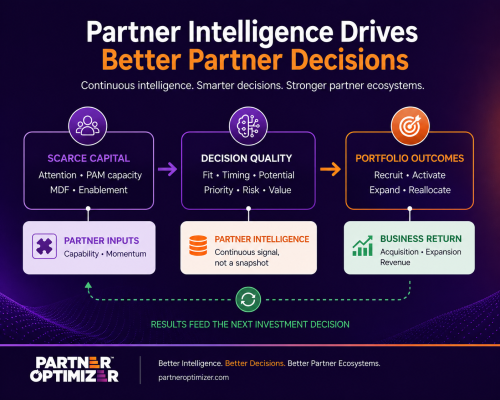
High-performing ecosystems aren’t built by companies that execute harder. They’re built by companies that make better decisions about where execution should begin — and Partner Intelligence is what makes those decisions possible before, during, and after.
Imagine two technology companies with remarkably similar partner organizations. Comparable budgets. Similar numbers of Partner Account Managers. Comparable enablement programs, partner marketing resources, executive sponsorship, and technology. Both believe partnerships are central to growth. Three years later, one ecosystem consistently influences customer acquisition and expansion. The other continues to work hard without producing comparable results.
Our instinct is to look at execution. We ask whether one company recruited more effectively, onboarded partners faster, enabled them better, or generated more joint pipeline. Those are reasonable questions. But they all examine what happened after the organization had already decided where to invest its people, time, and capital.
I think the more interesting question comes earlier. What if the advantage never started with execution at all? What if it started with the quality of the decisions that determined where execution began?
Every partner ecosystem is an investment portfolio. Every partner represents a decision to commit finite resources in the expectation of future return.
We rarely describe partner ecosystems this way, but we should. Executive attention, PAM capacity, MDF, technical enablement, co-selling, customer introductions, marketing programs — these are all forms of capital. None are unlimited. Every decision to invest in one partner is, by definition, a decision not to invest somewhere else.
Investment managers aren’t judged by how many investments they make. They’re judged by the quality of those investments over time. The same principle applies here. High-performing ecosystems are built because organizations repeatedly make better decisions about which relationships deserve investment, which should be accelerated, which should be monitored more closely, and which no longer align with where the business is going.
Exhibit 1
The Partner Portfolio Decision Model
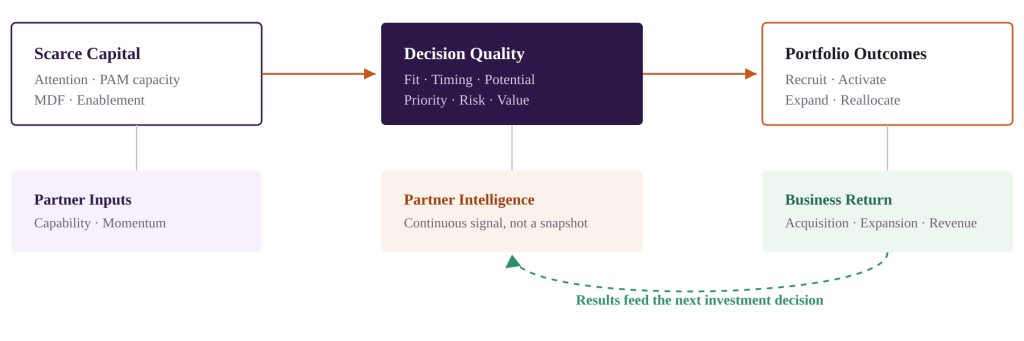
Partner organizations allocate scarce capital across a portfolio of relationships. The quality of that allocation — not the volume of activity around it — is what compounds into outcome.
One assumption quietly underpins many partner strategies: the belief that partners change slowly enough for annual planning to remain relevant. I’m no longer convinced that’s true.
Technology partners evolve continuously. They launch AI practices, acquire companies, expand into new industries, hire experienced leaders, develop new capabilities, earn certifications, reposition their businesses. Some become dramatically more valuable in a matter of months. Others gradually drift from the markets your company is pursuing. The ecosystem can appear stable while its strategic value shifts underneath.
In the first issue of The Partner Intelligence Journal, I described this as the Partner Intelligence Gap: the growing distance between what organizations believe about their ecosystems and what is actually true. The gap matters, but it’s only the beginning of the conversation. The more important question is what organizations choose to do about it.
For years, many companies treated partner intelligence as something you did before recruiting a new partner. Research the company. Evaluate the fit. Make a decision. That’s too small a role. The real purpose of Partner Intelligence is to improve decision quality across the entire partner lifecycle — including the decisions no one is actively making about the partners already inside the ecosystem.
That begins with business strategy. Where does the company intend to grow? Which customers matter most? Which industries are becoming priorities? Which technologies are changing customer demand? Those questions lead naturally to another: what kind of partners will actually help us get there?
One of the most encouraging changes I’m seeing is who participates in that conversation. Defining an Ideal Partner Profile is becoming less of a partner-team exercise and more of a cross-functional strategy discussion. Leaders from go-to-market, sales, partner marketing, demand generation, product, and customer success are starting with a shared business objective instead of a list of desirable partner attributes.
Exhibit 2
A Cross-Functional Ideal Partner Profile
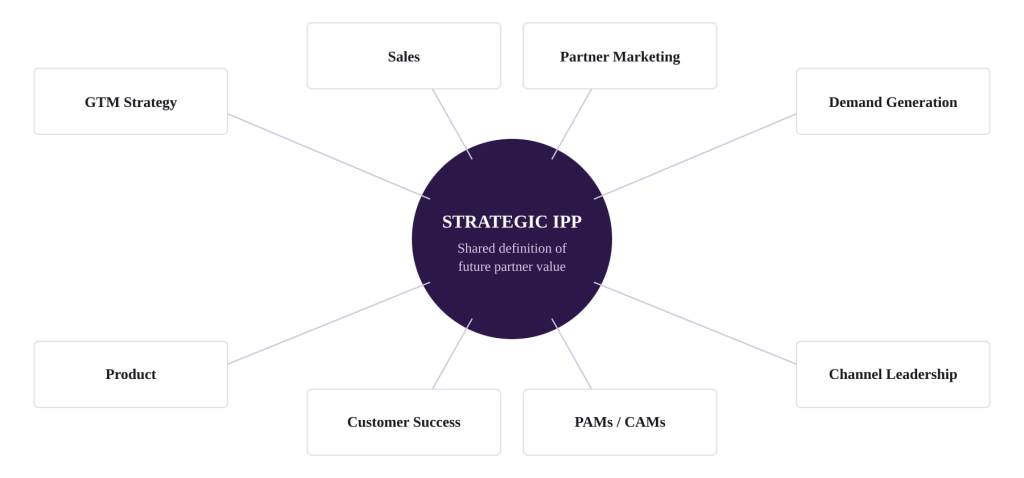
The strongest IPPs today reflect shared business priorities rather than a single functional perspective — which changes not just who defines fit, but how fast the definition stays current.
The Ideal Partner Profile becomes the organization’s best current hypothesis. Continuous Partner Intelligence tests that hypothesis against a market that refuses to stand still. Existing partners are monitored with the same discipline applied to discovering new ones. Competitive ecosystems reveal white space. Market signals expose emerging opportunity. Meaningful change surfaces while there’s still time to act on it.
At first glance, spending more time on strategy and intelligence looks like it should slow the process down. In practice, it’s the fastest path to revenue available. Organizations spend slightly more effort before recruitment begins so they can spend substantially less effort recruiting, enabling, and supporting partners that were never likely to create meaningful value. The recruiting motion gets more precise. Existing partners with newly relevant capabilities get activated sooner. Customer acquisition accelerates because the path between partner decision and customer opportunity contains less friction. Customer expansion accelerates because evolving partners are recognized while the opportunity still exists.
Exhibit 3
Where the Time Actually Goes
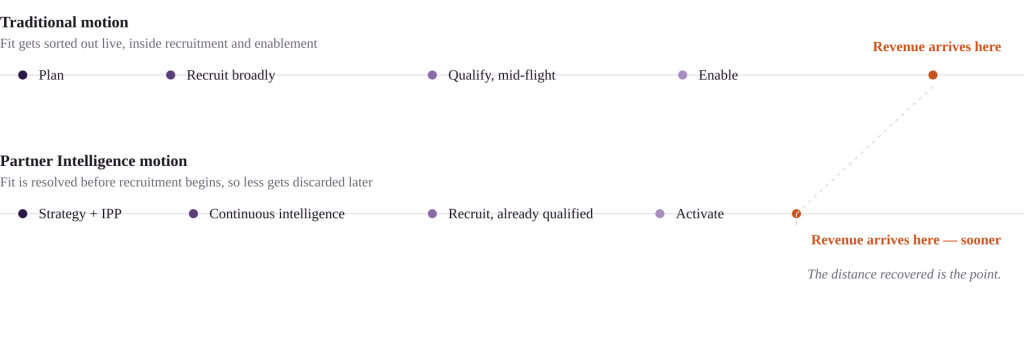
The goal was never a longer process. It’s a better allocation of effort, positioned earlier, so the path from strategy to revenue gets shorter — and the partners who arrive are the ones worth the acceleration.
Most partner decisions don’t look especially important on the day they’re made. Assigning one Partner Account Manager. Funding one campaign. Scheduling one executive meeting. Prioritizing one company over another. None appears transformational in isolation. Ecosystems are built through thousands of decisions that compound over time. Small improvements in decision quality rarely produce small improvements in business outcomes.
Where this sits
Business strategy determines where an organization wants to grow. Partner execution determines how effectively it recruits, enables, engages, and expands relationships. Between those two disciplines sits Partner Intelligence — the decision layer that continuously connects strategy to execution.Exhibit 4
Partner Intelligence as the Decision Layer
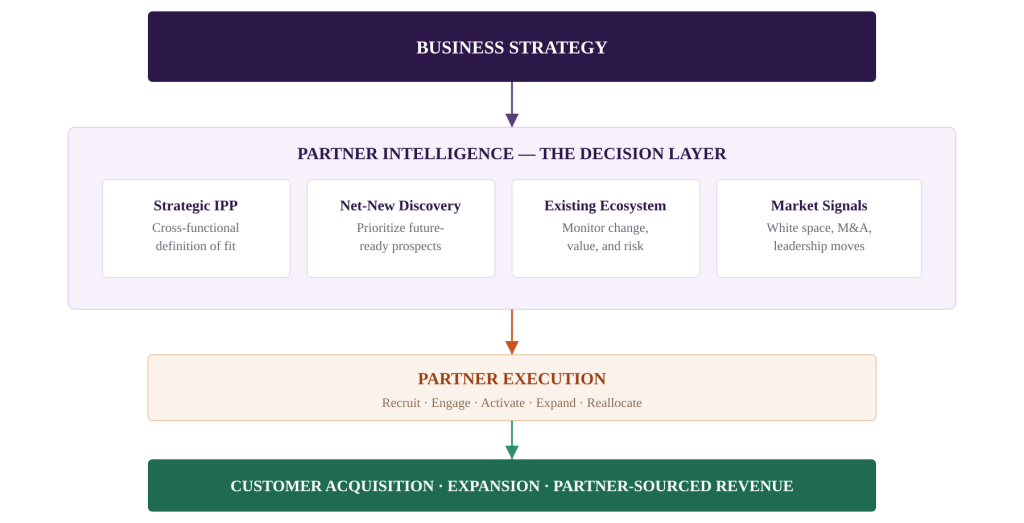
Partner Intelligence isn’t a research step before recruiting. It’s the continuous layer that sits between what the business decided to do and what the partner organization is actually doing about it.
I suspect the next decade of partnerships will be defined less by organizations that simply execute better, and more by those that consistently make better partner decisions. They’ll identify future-ready partners sooner, recognize changing opportunity faster, invest with greater confidence, and adapt before competitors realize the market has shifted. Those advantages come from making slightly better decisions, thousands of times over. That’s what enduring ecosystems have always done. We’re finally developing the intelligence to do it deliberately.
Not rhetorical. Worth actually answering in the room.
Dina Moskowitz is the founder and CEO of PartnerOptimizer, the strategic data layer for partner revenue. She writes The Partner Intelligence Journal on how ecosystem leaders make better decisions about where partnerships create the most value. partneroptimizer.com