
The Partner Intelligence Journal | Issue #3
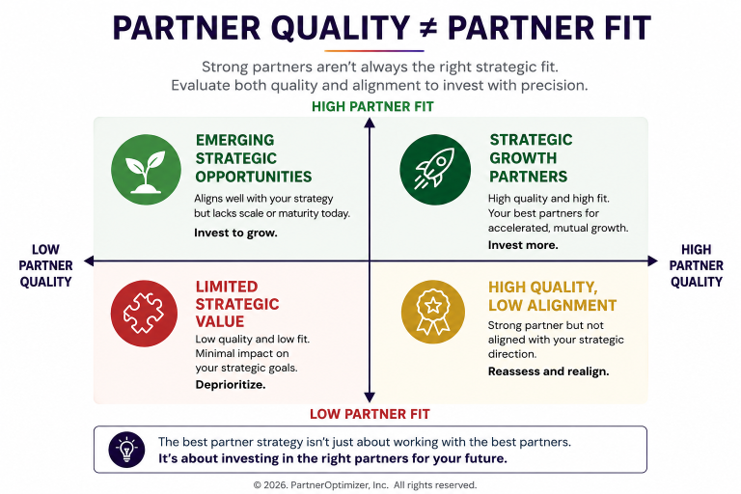
The strategic center of gravity reveals which companies fit your growth strategy, which could be shaped toward it, and which deserve a different level of investment.
Partner quality tells you whether a company is capable. Partner fit tells you whether that capability is likely to create value for your strategy.
A partner’s strategic center of gravity is the combination of forces that shapes where the company places its attention and builds momentum. It includes what the business sells most often, where it is investing, which customers it understands deeply, which technologies dominate its portfolio and team expertise, which vendors receive executive attention, and where new capabilities are forming.
This center of gravity is rarely captured in a single system. Revenue history may show what the partner sold through your program. Certifications may show what the partner was trained to deliver. A CRM may document meetings and opportunities. None of those records, by itself, explains what the partner is becoming.
Consider two partners with similar size, geography, customer coverage, and technical credentials. One is hiring specialists in your category, publishing related customer stories, building a managed service around the technology, and giving the practice visible executive sponsorship. The other maintains the certification but directs most of its energy toward adjacent services and competing vendors. On paper, both may qualify.
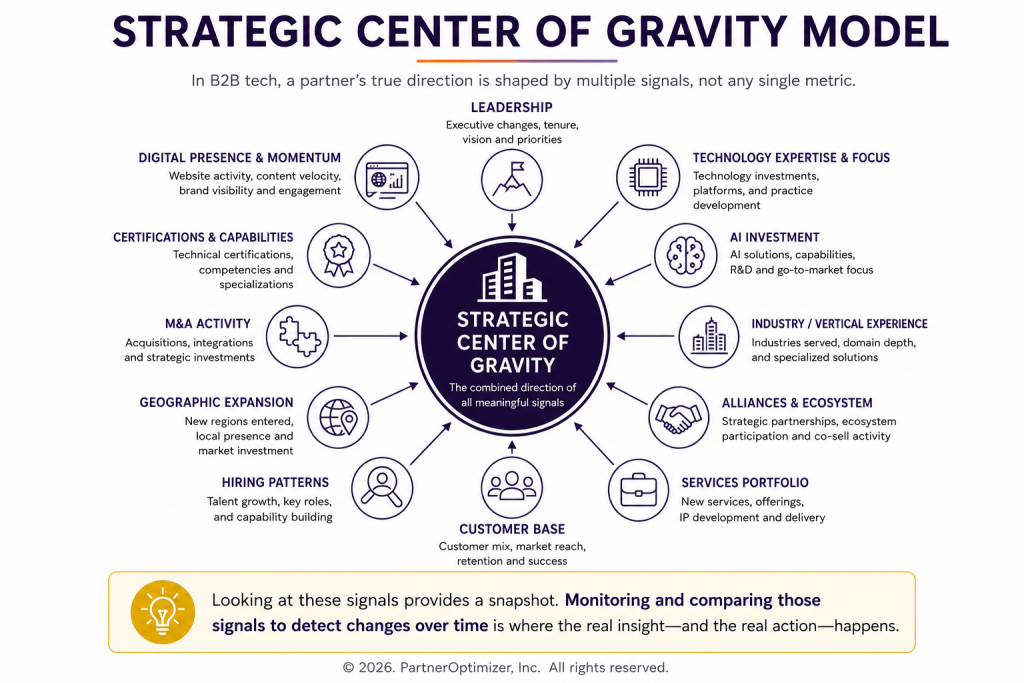
Understanding the center of gravity requires more depth than a conventional firmographics partner profile. The relevant dimensions depend on the business strategy, but they often include:
The objective is not to create a longer checklist. It is to understand the relative weight of these signals. A partner with moderate current revenue may have strong strategic momentum. A historically important partner may still produce revenue while gradually moving away from the category. Precision comes from seeing both the current contribution and the direction of travel.
Neither strategy is inherently better. In fact, each strategy can be further parsed based upon a strategy focused on existing partners or recruiting net new. The mistake is treating them as the same. An acceleration partner should be evaluated on readiness and the ability to produce results sooner. An expansion partner should be evaluated on potential, executive willingness, investment capacity, and the economics of helping the company build a new practice.
When the two are mixed into one broad definition of a good partner, expectations become confused. Teams recruit adjacent companies but manage them as if they were already committed. They invest heavily in enablement without confirming that the partner intends to shift its center of gravity. Or they overlook highly aligned specialists because those companies do not resemble the program’s historically largest partners.
“We’d greenlight partner bets on profiles that were essentially historical fiction, accurate the day they were captured and obsolete by the time we acted.”
Scott J. | Channel Revenue Architect and global mobility sector partner ecosystem leader
“The objective is not simply to know more about partners. It is to make better investment decisions earlier, and to reallocate resources before weak assumptions become expensive habits.”
Jens Walter | VP B2B Germany, Partner-Led GTM and Ecosystem Growth
1 Which partners look strong through the lens of our products but are investing most of their energy somewhere else?
2 Are we seeking partners ready to accelerate now, or partners we intend to help build a new practice?
3 Does our current segmentation preserve the reasoning behind each investment decision?
About the author: Dina Moskowitz is the founder and CEO of PartnerOptimizer, the strategic data layer for partner revenue. She writes The Partner Intelligence Journal on how ecosystem leaders make better decisions about where partnerships create the most value.