
The Partner Intelligence Journal | Issue #3
PRMs, ecosystem platforms, AI agents, and automation perform better when they operate on a precise, current understanding of every partner.
Partner organizations are entering a period of rapid technology expansion. PRMs are becoming more capable. Ecosystem platforms are connecting more workflows. AI agents can summarize accounts, recommend actions, generate communications, and support partner-facing teams. Custom GPTs and copilots are making institutional knowledge easier to access.
These developments are valuable. They can remove friction, improve consistency, and help partner teams act at a scale that was previously difficult to achieve. They also raise a more fundamental question: what intelligence are these systems using when they decide what to recommend, prioritize, or automate?
Technology multiplies the quality of the intelligence it receives. That makes the layer beneath the workflow more important, not less.
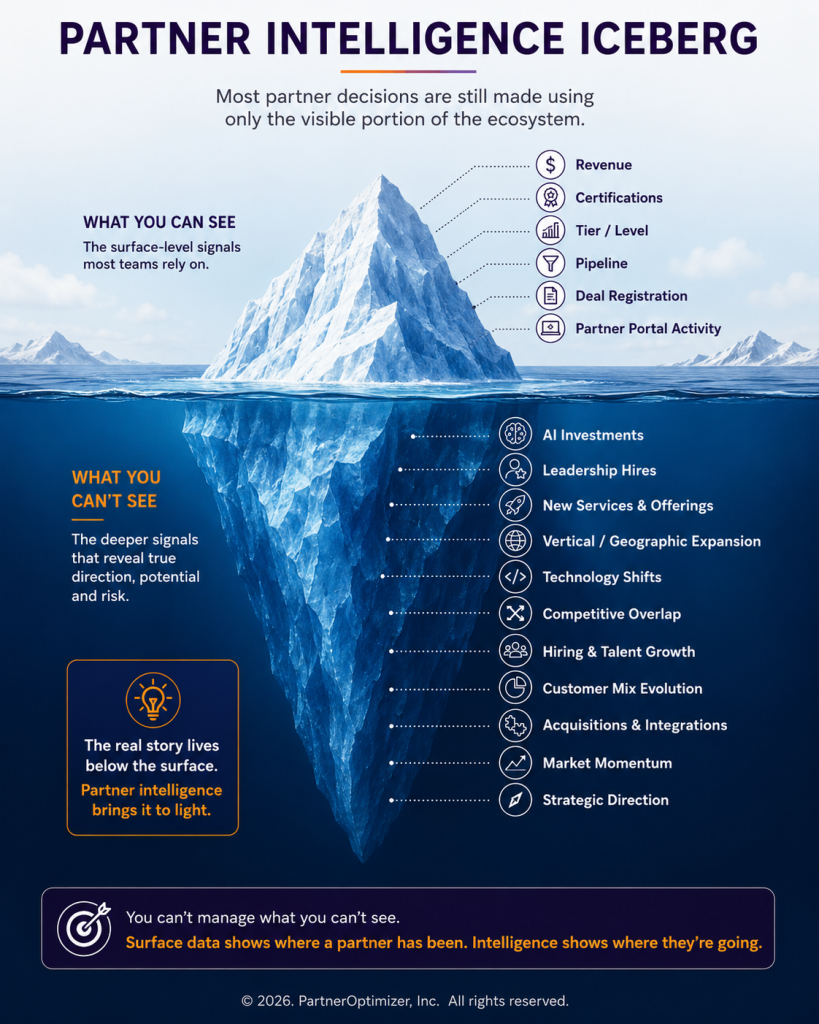
Most partner technology was designed around known relationships and program activity. It records who the partner is, which tier it occupies, who owns the relationship, what training has been completed, which opportunities are registered, and which campaigns are underway. Those functions are essential for operating a program.
The limitation is not that the systems fail at their intended purpose. The limitation is that a record of the relationship is not the same as a current understanding of the company. A partner can change its market focus, leadership, capabilities, customer base, technology alliances, and investment priorities without those changes appearing quickly or consistently in the vendor’s systems.
As a result, a workflow may execute perfectly against an incomplete view. The system can route a task, trigger a campaign, recommend a meeting, or generate an account plan. It cannot guarantee that the partner still deserves the same priority or that the opportunity being pursued reflects the partner’s current center of gravity.
Before AI, incomplete partner intelligence often produced slow or uneven decisions. A Partner Account Manager relied on personal knowledge. A marketing team reused last year’s segment. A recruitment team worked from a familiar list. The consequences were real, but the pace of execution placed a natural limit on how quickly those assumptions spread.
AI changes the speed. An agent can generate dozens of recommendations, communications, summaries, and next steps in the time it once took to prepare one. That is useful when the underlying context is strong. When the context is stale, narrow, or overly dependent on internal records, automation can scale the wrong conclusion with impressive efficiency.
This is not an argument against AI. It is an argument for preparing the intelligence environment that allows AI to contribute at a strategic level. A capable agent should know more than the partner’s tier and recent activity. It should have access to current signals about what the partner sells, where it is investing, which customers it serves, how its technology portfolio is changing, and whether its direction aligns with the company’s priorities.
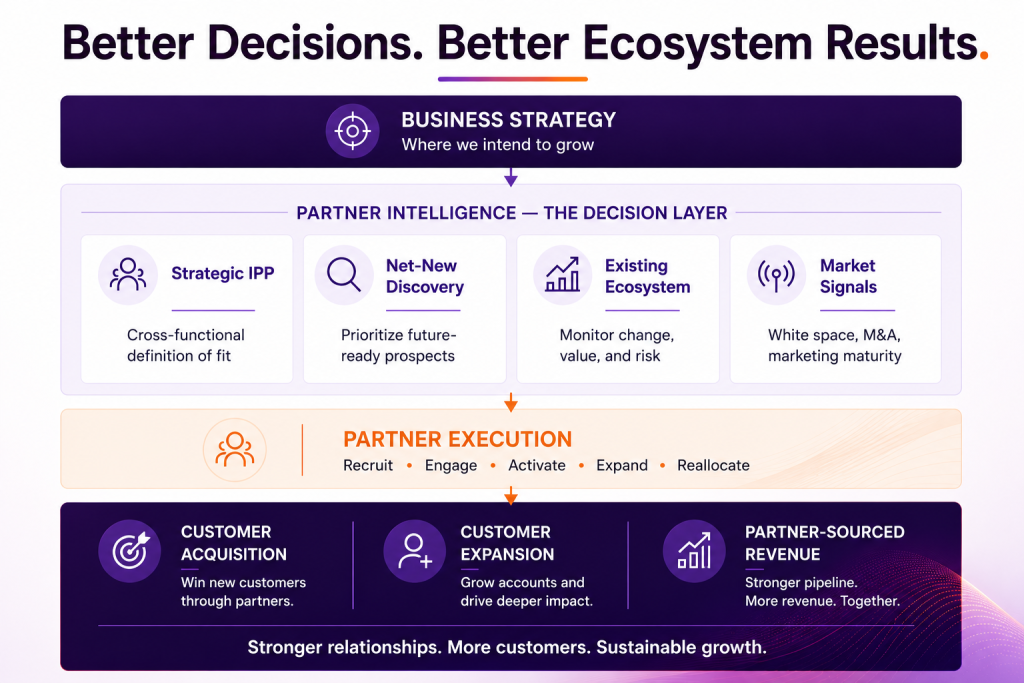
The intelligence layer sits between business strategy and partner execution. It translates strategic objectives into the attributes, signals, and market context needed to evaluate partners. It also keeps that understanding current enough to inform the systems and people responsible for action.
A strong intelligence layer helps answer questions such as:
These answers can then improve the tools already in place. A PRM can support more meaningful segmentation and workflows. An ecosystem platform can apply richer context to overlap and co-selling decisions. An AI agent can generate recommendations grounded in the partner’s current business rather than a thin internal record. Analytics can reflect strategic potential as well as historical activity.
There is a temptation to treat the next platform or agent as the place where the organization will finally solve partner prioritization. Technology can help operationalize a strategy, test it, refresh it, and make it usable across a large organization. It should not be expected to create strategic clarity from data that was never assembled for that purpose.
The distinction matters because many partner questions are judgment questions. Is this company already committed to our category, or would we be asking it to build a new practice? Does its customer base create a meaningful route to growth? Is the partner strategically aligned, merely active, or simply familiar? Which signals indicate potential, and which only indicate size?
Those decisions require a defined Ideal Partner Profile, a current view of the ecosystem, and enough external context to interpret what the company is doing beyond the vendor relationship. Once that foundation exists, technology becomes a powerful multiplier.
The goal is not to create another isolated database. The goal is to establish a current, structured understanding that can inform the systems where partner teams already work. Partner intelligence should strengthen the operating environment, not compete with it.
This creates a practical sequence. Start with the business outcomes the ecosystem is expected to support. Define the partner characteristics and signals relevant to those outcomes. Assess existing and potential partners with sufficient depth. Then connect that intelligence to the platforms, analytics, agents, and workflows that drive execution.
A chess engine is valuable because it can evaluate a position and consider many moves. It still depends on an accurate representation of the board. A golf professional can improve a swing because the trajectory, conditions, and objective are visible. In the same way, partner technology becomes more useful when it begins with a precise understanding of the ecosystem it is being asked to influence.
The next generation of partner organizations will not choose between intelligence and technology. They will build the intelligence layer that allows technology to perform at its highest level. That foundation will help them automate with more confidence, personalize with more relevance, and direct scarce resources toward the partners most likely to create strategic and revenue value.
01 What assumptions about partner fit are embedded in our systems, workflows, and AI prompts?
02 Which external changes to a partner would materially alter the actions our technology recommends?
03 Where could a stronger intelligence layer improve the return on technology we already own?
“The TAPEM Analysis (a total addressable market metric for partnerships) associated with the IPP is a well-structured strategic tool that not only provided a line of sight into how many more partners fit the strategy for this campaign, but the size of the candidate pool helped to validate the business opportunity itself.
As we move into outreach, our team is more prepared than ever, equipped with real intelligence instead of assumptions, and confident in exactly who to approach and why.”
Lauren Ventura | Sr. GTM Consultant – Bridge Partners for Microsoft as the Client
About the author: Dina Moskowitz is the founder and CEO of PartnerOptimizer, the strategic data layer for partner revenue. She writes The Partner Intelligence Journal on how ecosystem leaders make better decisions about where partnerships create the most value.